Why No-Signup Email Is Safer Than Regular Email (2026 Privacy Guide)
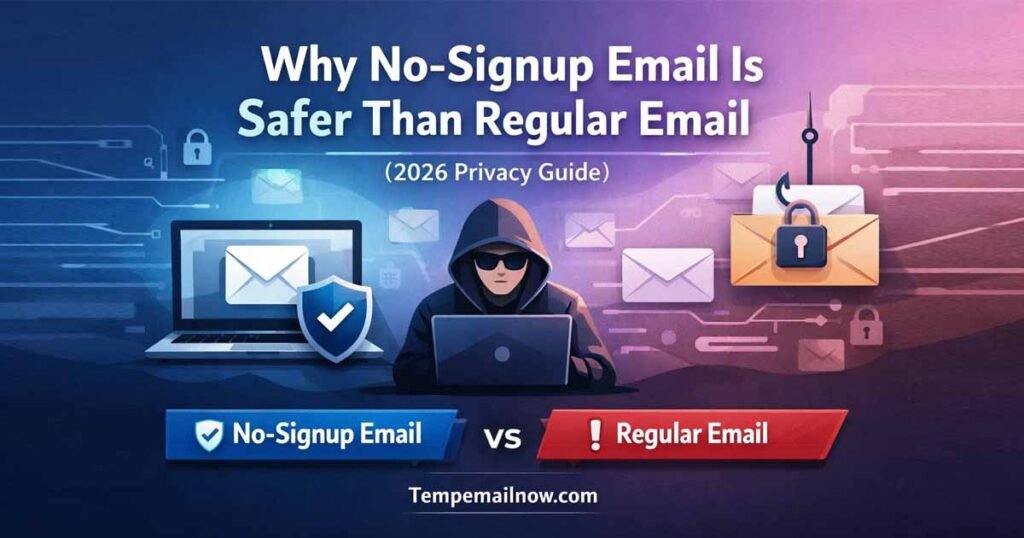
(Tempemailnow.com) – No-signup email is safer than regular email for many everyday online tasks because it reduces identity exposure, lowers spam risk, and limits long-term tracking. When you use your real email everywhere, you create a permanent digital trail that attackers, data brokers, and spam networks can exploit for years.
In 2026, privacy is not just about “hiding.” It’s about controlling what becomes permanent. And your email address is one of the most permanent identifiers you share online.
This guide explains why no-signup email can be safer than regular email, when you should use it, and when you should stick with your primary inbox.
What Is No-Signup Email?
A no-signup email is a temporary or disposable email address that works instantly without creating an account. It typically:
- Generates an inbox immediately
- Requires no registration or password
- Expires automatically after a short time (depending on the service)
- Keeps your real email private
If you want to understand how this works as a service (without reading a technical explanation), see this page:
Temp Email Now Blogs
The Hidden Risks of Using Regular Email Everywhere
A regular email address (Gmail, Outlook, Yahoo, business email) is designed for long-term identity. That’s perfect for banking, work, and important accounts — but risky for random signups, downloads, trials, and unknown websites.
Here’s why.
1) Permanent Identity Exposure
When you enter your real email on websites:
- It becomes linked to accounts, newsletters, and signups
- It can be shared, sold, or leaked
- It becomes a long-term identifier used to profile you
- You can’t “reset” your online footprint
Even if you unsubscribe later, the email address is already stored somewhere — sometimes in many places.
Once exposed, the damage is hard to reverse.
2) Spam Lists and Data Broker Networks
Spam doesn’t happen randomly. It’s often the result of:
- Marketing partners exchanging user lists
- Websites selling email databases
- Poor security practices
- Third-party scripts capturing signup data
One email used “just one time” can turn into years of junk mail, promotions, fake offers, and risky links.
No-signup email protects you because the inbox is temporary. The spam has nowhere permanent to live.
3) Higher Risk During Data Breaches
When a site is breached, attackers may obtain:
- Your email address
- Your account password (hashed or sometimes plain)
- Your login patterns (where you sign up)
Then they attempt:
- Phishing (fake login pages, fake invoices, fake security alerts)
- Credential stuffing (trying the same password on other sites)
- Social engineering based on your signup history
Using your real email across many sites increases your exposure. With no-signup email, the “breach value” of your identity can be much lower.
Why No-Signup Email Is Safer Than Regular Email
Now the core reasons — the practical safety advantages. Need a disposable email to protect your real inbox?.
1) No Personal Data to Steal
Most no-signup email workflows do not require:
- Name
- Password
- Phone number
- Recovery email
- Identity verification
When there’s no registration, there’s less personal data attached to the inbox.
No data collected = less damage possible.
2) Reduced Attack Surface
Because no-signup email is usually:
- Temporary
- Session-based
- Not reused long-term
Attackers cannot build a lasting profile or “history” around it.
Your real email is a stable target. A disposable inbox is a moving target.
3) Automatic Expiration = Automatic Protection
Regular emails last forever. That’s exactly the problem.
No-signup email often expires by design, which reduces:
- Long-term spam
- Follow-up phishing attempts
- Unwanted “we saved your email” marketing reminders
- Old accounts being reactivated
Even if a website keeps sending emails, the inbox will eventually disappear.
4) Safer for OTPs and Quick Verifications
Many people now use no-signup email for:
- One-time passwords (OTPs)
- Trial signups
- Test registrations
- Download links
- App testing and QA
This is useful because OTP and verification flows are exactly where spam and tracking get aggressive.
If your goal is simply “get the code, finish the action, leave,” a no-signup email is often safer than exposing your main inbox.
When You Should Use No-Signup Email
No-signup email is ideal for:
- Websites you don’t fully trust
- Free trials, coupons, or gated downloads
- Newsletter signups you may not keep
- Testing apps, forms, and onboarding flows
- Temporary verifications and one-time actions
- Protecting your real inbox from marketing spam
If your task is short-term, your email should be short-term too.
When You Should NOT Use No-Signup Email
Use your real email (or a long-term email alias) for:
- Banking and financial accounts
- Government or official services
- Work tools, payroll, client accounts
- Password managers and recovery emails
- Anything you must access months/years later
No-signup email is great for quick tasks, not for long-term account ownership.
No-Signup Email vs Regular Email (Quick Comparison)
| Feature | No-Signup Email | Regular Email |
|---|---|---|
| Registration required | ❌ No | ✅ Yes |
| Personal data exposure | 🔽 Low | 🔼 High |
| Spam risk | 🔽 Low | 🔼 High |
| Data breach impact | 🔽 Limited | 🔼 Bigger |
| Long-term tracking | ❌ Minimal | ✅ Common |
| Best for | OTPs, trials, downloads | Banking, work, recovery |
How No-Signup Email Improves Online Privacy
Online privacy is not only about blocking trackers. It’s also about separating identity from activity.
No-signup email helps you separate:
- Your real identity (primary email)
- Your temporary actions (signups, trials, downloads)
This separation is one of the simplest privacy upgrades you can make — and it often requires no effort beyond choosing a temporary inbox when needed.
If you want the platform overview and how it works in practice, use this:
What Is Temp Email Now?. Temp Email Now Mozilla Addons.
Final Thoughts
No-signup email is not just convenient — it’s a practical risk-reduction tool.
By limiting identity exposure, reducing spam, and preventing long-term tracking, disposable inboxes can make everyday web usage safer. In a world where data leaks are common and spam networks are aggressive, not sharing your primary email everywhere is one of the smartest privacy habits you can build.