Newsletter Spam Protection: The Hidden Risk of Sold Marketing Lists
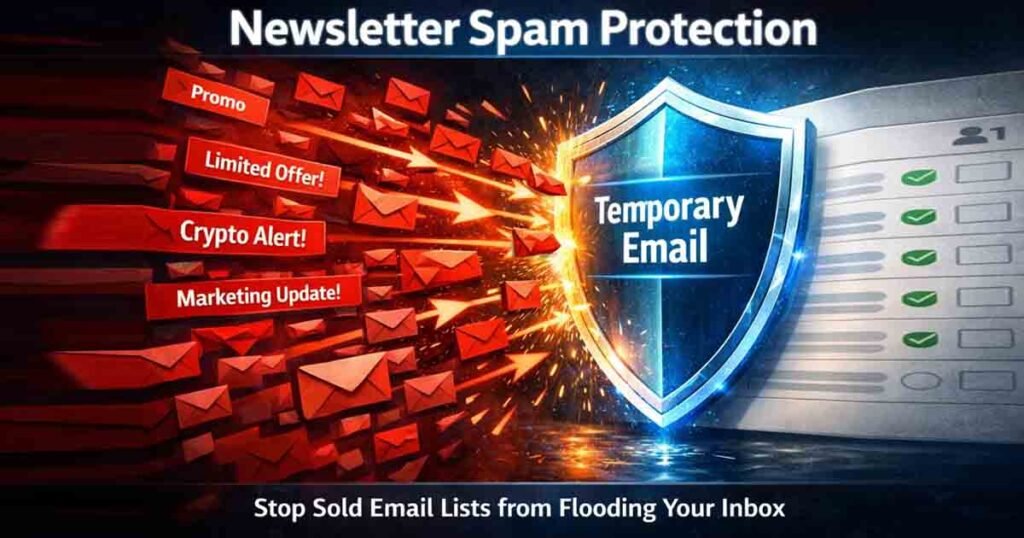
(Temp Email Now) – Newsletter spam protection has become more important than ever. What seems like harmless email signups can quietly expose your inbox to marketing networks, data brokers, and third-party advertisers.
You download a free guide.
You sign up for a discount code.
You register for a webinar.
Weeks later, your inbox is full of unrelated promotional emails.
This is not random. It is how the email marketing ecosystem operates.
Let’s break down how newsletter spam spreads — and how temporary email services act as a firewall for your primary inbox.
How Marketing Lists Are Bought and Resold
When you submit your email address online, several things may happen behind the scenes.
1. Data Brokers and Email Segmentation
Email addresses are grouped into targeted categories such as:
- Online shoppers
- Tech users
- Students
- Investors
- Small business owners
These categorized lists are often:
- Sold
- Rented
- Shared with advertising partners
- Uploaded into ad platforms
Even when companies claim they do not “sell” your data, privacy policies often allow data sharing with trusted partners.
Once your email enters these networks, distribution becomes difficult to control.
2. The “Free Resource” Trap
Free ebooks, discount coupons, trial access, and giveaways often require email registration.
Many of these forms include consent language that allows:
- Partner marketing
- Affiliate promotions
- Third-party advertising
Users rarely read the fine print. But legally, that consent enables list expansion.
3. Scraping and Harvesting
Spammers also use automated tools to collect publicly available email addresses from:
- Forums
- Business websites
- Comment sections
- Public directories
These harvested emails are added to bulk mailing databases.
4. Overselling of Lists
One major cause of sudden spam increases is list overselling.
A single list may be resold multiple times across marketing exchanges. This results in:
- Unrelated product promotions
- Cryptocurrency campaigns
- Financial offers
- Software trials
- Affiliate newsletters
Once widely circulated, removing your email becomes nearly impossible.
Why Newsletter Spam Is More Than an Annoyance
Many people treat spam as a minor inconvenience. But it carries real risks.
Security Threats
Spam emails may include:
- Phishing links
- Fake login portals
- Malware attachments
- Identity theft attempts
The more widely your email circulates, the higher the risk exposure.
Data Breach Amplification
If your primary email is used everywhere, a breach at one small website can expose it to thousands of additional marketers.
Your inbox becomes permanently more vulnerable.
How Temporary Email Addresses Act as a Firewall
The most effective newsletter spam protection method is limiting exposure before it begins.
Temporary email services create disposable inboxes that shield your real address.
Instead of using your primary email for every signup, you use a temporary address for:
- Newsletter subscriptions
- Free downloads
- Trial accounts
- Discount codes
- One-time verifications
If spam follows, it remains inside that disposable inbox — not your real one.
This separation functions like a digital firewall.
Benefits of Using Temporary Email for Spam Protection
1. Risk Isolation
Each temporary address contains its own exposure.
If a website sells its mailing list, only that temporary inbox is affected.
Your primary email remains clean.
2. Disposable Nature
Most temporary emails automatically expire.
Once the session ends, the inbox disappears — along with future spam.
3. Reduced Tracking
Temporary emails are not tied to your permanent digital identity.
This limits behavioral profiling across marketing networks.
4. No Long-Term Commitment
Many websites require email just to access content.
A temporary inbox lets you get what you need without committing to years of promotional messages.
When to Use a Temporary Email
Temporary email is ideal for:
- Downloading whitepapers
- Accessing gated content
- Joining forums
- Signing up for trials
- Testing new services
It is not recommended for:
- Banking
- Government services
- Work accounts
- Important subscriptions
For those, always use your secure primary email.
A Smarter Email Privacy Strategy
Instead of constantly unsubscribing from dozens of lists, structure your email usage strategically:
Primary Email → Banking, personal, critical accounts
Secondary Email → Trusted subscriptions
Temporary Email → Unknown or one-time registrations
This layered approach dramatically reduces spam exposure.
Why Newsletter Spam Will Continue to Grow
Email marketing remains one of the highest ROI channels in digital advertising.
As long as email lists generate revenue, list trading and sharing will continue.
The solution is not trying to stop the system — it is limiting your participation in it.
Final Thoughts on Newsletter Spam Protection
Newsletter spam protection starts with awareness.
Once your primary email enters large marketing ecosystems, removal is difficult.
Using temporary email addresses acts as a preventative firewall — blocking unnecessary exposure before it spreads.
Inbox privacy is not about avoiding newsletters.
It is about controlling when and where your real email is shared.
Protect your inbox first. Unsubscribe later.